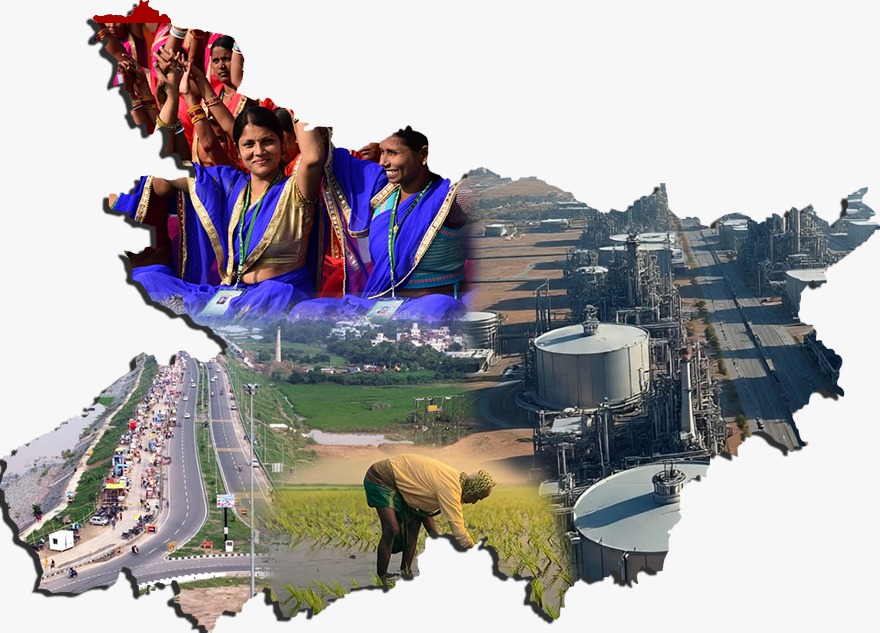
Over the past two decades, Bihar has demonstrated significant economic resilience, characterised by consistent improvements in Gross State Domestic Product (GSDP) and per capita income, as well as sectoral diversification. The Bihar Economic Survey 2025-26 highlights that the state's growth trajectory has often surpassed the national average, indicating robust economic momentum driven by public investment, infrastructure development and increased economic activity. As per the recent estimates, Bihar's GSDP in 2024-25 increased by 8.6 percent at constant prices and 13.1 percent at current prices. reaching Rs. 5,31,372 crore and Rs. 9,91,997 crore, respectively. Over the past three years, Bihar's GSDP growth has consistently outpaced India's GDP growth at both constant and current prices. The per capita GSDP for Bihar is estimated at Rs. 76,490 at current prices and Rs. 40,973 at constant prices in 2024-25, reflecting growth rates of 11.5 percent and 7.1 percent, respectively.
The sectoral composition of Gross State Value Added (GSVA) in Bihar has undergone a structural transformation, with the primary, secondary, and tertiary sectors contributing 18.3 percent, 26.8 percent, and 54.8 percent, respectively, in 2024-25 at constant (2011-12) prices. Gross Fixed Capital Formation in the state has nearly doubled over the past five years reaching Rs. 34,905 crore in 2024-25, with its share in GSDP rising to 3.5 percent.
Overall, the Bihar Economic Survey 2025-26 provides an optimistic, forward-looking evaluation, concluding that the state is progressing along a high-growth trajectory, supported by macroeconomic stability, sectoral diversification, increased investment, and a sustained focus on human capital development, employment generation, and infrastructure enhancement.
Bihar Economy: An Overview
1. As per the latest quick estimates for 2024-25, Bihar's Gross State Domestic Product (GSDP) at constant (2011-12) prices increased by 8.6 percent, while at current prices it expanded by 13.1 percent, reaching Rs. 5,31,372 crore and Rs. 9,91,997 crore respectively.
2. Over the past three years, Bihar's economic growth has consistently outpaced India's GDP growth, both at current and constant prices. Bihar's GSDP growth rates reached 17.9 percent in 2022-23 and 14.9 percent in 2023-24, compared to India's 14.0 percent and 12.0 percent respectively at current prices. As per the quick estimates for 2024-25, Bihar's GSDP (current prices) growth is estimated at 13.1 percent and India's GDP growth at 9.8 percent. At constant (2011-12) prices, Bihar's economy is estimated to have achieved 8.6 percent growth in 2024-25, exceeding India's 6.5 percent. These figures place Bihar among the fastest-growing states in India.
3. The quick estimates for 2024-25 indicate that the secondary sector's Gross State Value Added (GSVA) in Bihar grew by 11.1 percent at constant (2011-12) prices and 15.5 percent at current prices. The tertiary sector followed with growth rates of 8.9 percent at constant prices and 13.5 percent at current prices, while the primary sector recorded increases of 4.1 percent at constant prices and 9.6 percent at current prices.
4. Between 2020-21 and 2024-25, the secondary sector's share of Bihar's GSVA at constant (2011-12) prices increased substantially from 21.1 percent to 26.8 percent, mainly due to growth in construction and manufacturing sectors. In contrast, the primary sector's share declined from 21.9 percent to 18.3 percent, while the tertiary sector's share decreased from 57.0 percent to 54.8 percent. These changes indicate increasing diversification in the state's economic activities.
5. Bihar's per capita GSDP at current prices increased from Rs. 46,412 in 2020-21 to Rs. 76,490 in 2024-25, showing a steady upward trend. At constant (2011-12) prices, per capita GSDP rose from Rs. 30,159 to Rs. 40,973 during the same period.
6. Within Bihar, the Patna district recorded the highest per capita Gross District Domestic Product (GDDP), followed by Begusarai and Munger. The per capita GDDP at current prices was Rs. 2,41,220 for Patna, Rs. 1,05,600 for Begusarai, and Rs. 93,921 for Munger.
7. Overall, the Bihar Economic Survey 2025-26 presents an optimistic and forward-looking assessment, highlighting that the state is progressing along a high-growth trajectory supported by macroeconomic stability, sectoral diversification, increased investment, and continued focus on human capital development, employment generation, and infrastructure improvement.
State Finances
1. Bihar's fiscal trajectory demonstrates disciplined financial management, as total expenditure by the State government increased from Rs. 1.66 lakh crore in 2020-21 to Rs. 2.82 lakh crore in 2024-25. The State government has consistently prioritised developmental outlays in sectors such as education, health, energy, transport, irrigation, and agriculture, while maintaining fiscal prudence through moderate borrowing and effective debt servicing.
2. The proportion of capital expenditure in total expenditure by the State government rose significantly from 15.8 percent in 2020-21 to 22.3 percent in 2024-25, while the share of revenue expenditure declined from 84.2 percent to 77.7 percent. This structural change underscores the government's focus on long-term investment, infrastructure development, and asset creation.
3. Receipts by the State government in its revenue account increased from Rs. 1.28 lakh crore in 2020-21 to Rs. 2.18 lakh crore in 2024-25, with tax revenue emerging as the major source. The share of tax receipts in the revenue account rose from 70 percent to 84 percent, while non-tax revenue decreased from five percent to two percent, and the share of grants-in-aid declined from 25 percent to 14 percent.
4. The composition of revenue expenditure has remained largely stable over the past five years, with Social Services sector constituting the largest share at 46 percent. The share of Economic Services sector increased slightly from 21 percent in 2020-21 to 22 percent in 2024-25, while that of General Services declined marginally from 33 percent in 2020-21 to 32 percent in 2024-25. This distribution demonstrates the State government's commitment to both welfare enhancement and strengthening productive sectors.
5. The share of scheme expenditure in the total State government expenditure has increased from 38.3 percent in 2020-21 to 39.9 percent in 2024-25 , while the proportion of Establishment and Committed Expenditure has declined slightly from 61.7 percent to 60.1 percent. This trend reflects a gradual shift toward welfare initiatives and policy-driven development priorities.
6. Developmental spending by the State government has consistently comprised approximately two-third of the budget, reaching 67.4 percent of the total expenditure in 2024-25. Developmental expenditure by the State government has increased from Rs. 1,12,122 crore în 2020-21 to Rs. 1,89,892 crore in 2024-25, indicating an increased focus on growth-oriented and welfare-related spending.
7. Receipts from the Central government has increased from Rs. 91,625 crore in 2020-21 to Rs. 1,59,298 crore in 2024-25, primarily due to increase in the transfer from the divisible tax pool, which rose from Rs. 59,861 crore in 2020-21 to Rs. 1,29,435 crore in 2024-25. Grants-in-aid from the Central government amounted to Rs. 29,863 crore in 2024-25. Concurrently, the State's own revenue has also increased from Rs. 36,543 crore in 2020-21 to Rs. 59,360 crore in 2024-25, with tax revenue as the main contributor.
8. As of March 31, 2025, the State government's outstanding debt stood at Rs. 3,74,134 crore, representing 37.7 percent of the State's Gross State Domestic Product (GSDP). The share of public debt within the total outstanding debt was 84.6 percent at the end of 2024-25. Of the total public debt, 83.8 percent originated from internal sources, while 16.2 percent was attributed to loans and advances from the Central government. Market loans and loans from financial institutions are the primary components of internal debt.