Swami Sahajanand Saraswati founded the Bihar Provincial Kisan Sabha in 1929, replacing the Kisan Sabha that Mohammad Zubair and Srikrishna Singh had formed in 1922. In 1936, All India Kisan Sabha was formed in Lucknow, and Swami Sahajanand Saraswati became its President. 'Hunkar', a Hindi weekly published in 1940 by Pandit Yamuna Karjee and Rahul Sanskrityayan, chronicled the peasant uprising in Bihar.
Dharnidhar Prasad and Shah Mohammad Zubair introduced the non-cooperation resolution at the Bihar Congress meeting in August 1920, which was presided over by Dr Rajendra Prasad.
Shah Mohammad Zubair and Mazhar-ul-Haq were included in Dr. Rajendra Prasad’s committee on the movement. In February 1922, M.K. Gandhi formally opened the 'Bihar National College' and the building it was housed in, ‘Bihar Vidyapeeth’. Anugrah Narayan Sinha called an All Party Meeting to call for a boycott of the Simon Commission. On December 12th, 1928, the commission reached Patna, where it was opposed with the slogans of ‘Simon go back’. Rambriksh Benipuri, Ramanand Mishra and Ganga Sharan Sinha established Bihar Socialist Party in 1931.Jai Prakash Narayan called a conference at Patna’s Anjuman Islamia Hall in 1934, and that’s when the Bihar Congress Socialist Party was established.
The first president was Archarya Narendra Dev, who appointed Jai Prakash Narayan as general-secretary. Mohammad Zubair and Sri Krishna Singh organised the Kisan Sabha in Munger in 1922.
The Government of India Act, 1935, which introduced constitutional remedies, provincial autonomy in the state and dual administration in the Centre. Sri Krishna Singh refused to form a government despite Congress having a sizable majority in the legislative council, where 8 candidates were victorious. Therefore, the independent candidates’ leader Mohammad Yunus formed the government making him the first Prime Minister of Bihar of minority government.Three months later on 20 July 1937, Sri Krishna Singh formed the cabinet. Sri Ramdayalu Singh and Prof. Abdul Bari served as the Legislative Council’s Speaker and Deputy Speaker, respectively. Shri Krishna Singh resigned after the British declared that India will be taking part in the Second World War and Congress began to protest the decision.
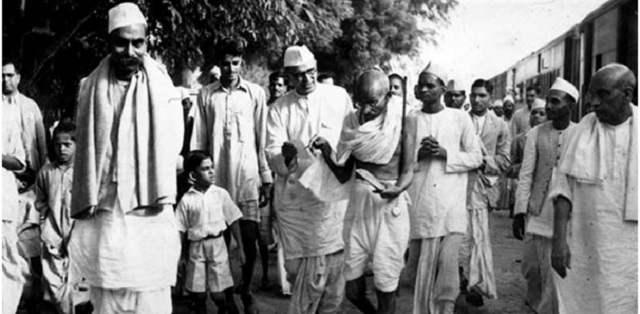
Quit India Movement in Bihar
The Quit India Movement was launched by Mahatma Gandhi on August 8th, 1942, which got support from all over India. The plan of action for the movement was drafted on July 31, 1942, by the Bihar Congress Committee, which was chaired by Dr. Rajendra Prasad. The national flag was unfurled everywhere but the British arrived in order to control the movement and to put an end to the movement. The District Magistrate of Patna W. G. Archer arrested Rajendra Prasad and he was sent to Bankipur jail. The advocate general Baldeva Sahay resigned from his office in protest to Govt. repression. Phulan Prasad Verma, Shrikrishna Sinha, Anugraha Narayan Sinha and some other leaders were also arrested. The students played a heroic role in this freedom movement.
On August 11, 1942, a band of students marched in order to hoist the national flag on the building of the Patna secretariat. Under the orders of the District Magistrate, the thirteen to fourteen rounds were fired in which seven students were killed and several were injured. The seven students martyrs were Umakant Sinha, Ramanand Singh, Jagatpati Kumar, Satish Prasad Jha, Devipada Choudhary, Rajendra Singh and Ram Govind Singh.
As a result of this incident, a widespread upheaval broke out spontaneously. There was a complete strike in Patna on August 12. The same evening a meeting was organised by Jagat Narayan Lal, in which it was decided to cripple the government machinery. To paralyse the administration, the agitators uprooted railways lines, damaged telegraphs wires and telephones, burnt police stations, seized post offices and other government buildings.
During the course of this movement, Jayaprakash Narayan escaped from Hazaribagh jail and formed the 'Azad Dasta' in the jungles of Nepal, which harassed the British through sabotage and guerrilla warfare. In some districts like Chapra and Bhagalpur, the agitators established parallel governments for some time.
Women held rallies, hoisted flags, and staged sit-ins, actively participating in the movement. Railway lines, telegraph and telephone lines and police stations across Bihar were targeted, paralyzing the administrative machinery. The powerful protest in Bihar shook British rule and paved the way for independence.