What to Visit
Pandu Pokhar
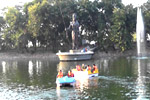
Breathtaking landscapes and fun-filled activities makes PANDU POKHAR – a paradise for all. From beautiful gardens to an open air theatre, to a pond overlooking 37 feet tall bronze statue of King Pandu to a herbal maze – we are a place to enjoy and admire nature. A park with a unique combination of entertainment and camping makes it a wonderful place for corporate events, school excursions, family and other social gatherings. Truly, a beautiful destination for a perfect vacation. Experience the goodness of nature with fun. Starting with adventurous Zipline and Zorbing, the park is filled with fun rides, games and pleasure gardens. At dusk, the display of colourful fountains in the pond enhances the beauty of the park. Evening walks in the serenity of the park allows nature’s peace to flow in, soothing the soul and mind.
Ghorakatora Lake
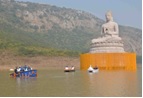
This is a lake surrounded by beautiful hills and one of the popular picnic spot of Rajgir. The name of this lake suggest a bowl of horse. The site of this lake is believed to be the place where the astabal of Jarashangh was situated. This is very beautiful natural lake.
Jarashand ka Akhara
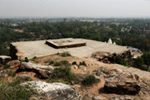
This is the Ranbhumi where Bhima and Jarasandh fought one of the Mahabharat battles.
Jivakamravan Gardens
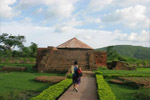
Seat of the Royal Physician's dispensary where Lord Buddha was once brought to have wound dressed by Jivaka, the royal physician during the reign of Ajatshatru and Bimbisara.
Ajatshatru Fort
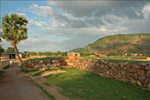
Built by Ajatshatru (6th century B.C.), the king of Magadha during the Buddha's time. The 6.5 sq.meter Ajatshatru's Stupa is also believed to have been built by him.
Cyclopean Wall
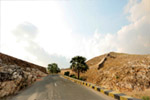
Once 40 Km long, it encircled ancient Rajgir. Built of massive undressed stone carefully fitted together, the wall is one of the few important Pre-Maurayan stone structures ever to have been found. Traces of wall still subsist, particularly at the exit of Rajgir.
Shanti Stupa
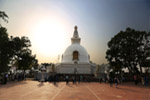
The Vishwa Shanti Stup is located on a 400 meter high hill. The stupa is built in marble and on the four corners of the stupa are four glimmering statues of Buddha. To reach the top of this hill one has to come through the “Ropeways”. This place is also called the GriddhKoot.
Venu Vana
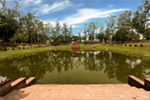
Site of the monastery Venuvana Vihar built by king Bimbisara for Lord Buddha to reside. This was the king's first offering to Lord Buddha.
Karanda Tank
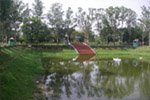
It is the tank in which Buddha used to take bath.
Sonbhandar Caves
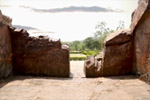
Two rather strange cave chambers were hollowed out of a single massive rock. One of the chambers believed to be the guard room, the rear wall has two straight vertical lines and one horizontal line cut into the rock; the doorway is supposed to lead to king Bimbisara Treasury. Inscriptions in the Sankhlipi or shell script, etched into wall and so far undeciphered, are believed to give the clue to open the doorway. The treasure, according to folklore, is still intact. The second chambers bears a few traces of seated and standing etched into the outer wall.
Bimbisar jail
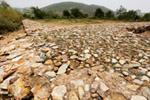
His impatient son and heir, Ajatashatru, imprisoned King Bimbisara here. The captive king chose this site for his incarceration, for, from this spot he could see Lord Buddha climbing up to his mountain retreat atop the Griddhakuta hill.
Veerayatan
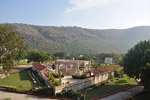
A Jain Temple and Museum.
Jain Temple
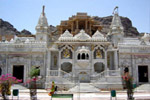
On hill crests around Rajgir, far in the distances one can see about 26 Jain Temples. They are difficult to approach for the untrained, but make exciting trekking for those in form.
Chariot Route Marks
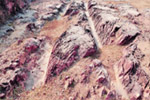
The Chariot Route and hell inscriptions are worth a visit for the strangeness of the phenomenon, two parallel furrows cut deep into rock for about thirty feet giving credence to the local belief that they were "burnt" into the rock by the speed and power of Lord Krishna's chariot when he entered the city of Rajgir during the epic Mahabharata times. Several shell inscriptions, the undeciphered characters current in central and eastern India from the 1st to 5th centuries AD, and engraved in the rock around the chariot marks.
Hot Springs
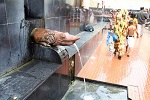
At the foot of Vaibhava Hill, a staircase leads up to the various temples. Separate bathing places have been organized for men and women and the water comes through spouts from Saptdhara, the seven streams, believed to find their source behind the "Saptarni Caves", up in the hills. The hottest of the springs is the Brahmakund with a temperature of 45 degree Centigrade.
Pippala cave
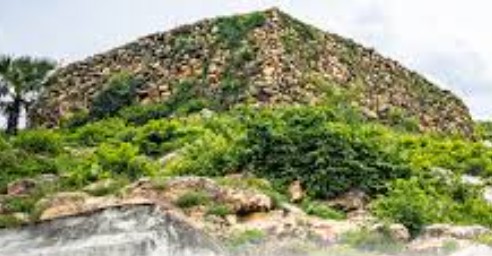
Above the hot springs on the Vaibhava Hill, is a rectangular stone sculpted by the forces of nature which appears to have been used as a watch tower. Since it later became the resort of pious hermits, it is also called Pippala Cave and popularly known as "Jarasandh ki Baithak" after the name of the King Jarasandh, a contemporary of Lord Krishna described in the epic Mahabharata.
Gridhakuta
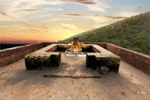
This was the place where the lord Buddha set in a motion his second wheel of law an for three months even during the rainy season, preached many inspiring sermons to his disciples.
Maniyar Math
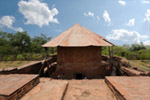
Maniyar Math occupies a prominent position inside the valley of Rajgir. Situated almost in the centre of the enclosure of the inner city on the way to the Sone Bhandar caves, there is this cylindrical well-like structure of archaeological importance. It is situated 1km from the Warm Water Spring. This well is covered by a small temple of the Jains. It is not dedicated to a Jain Tirthankara but to Naga Salibhadra who is said amongst the Jains buried his treasure inside the well. Jains offer their worship at this place to the presiding deity.